
How To Pay Less In Taxes
Eliminating Losing Financial Strategies
How to pay less in taxes, revealed in our free report,
TAXES the Largest Transfer of Your Wealth

Eliminating Losing Financial Strategies
Do you want to pay higher TAXES? If you are successful, you are a target of the IRS and the more you make, the more you pay. The secret is to keep more of what you earn, and to keep it in the family…
“The current fiscal policy is unsustainable. We are heading to a future where we’ll have to double federal taxes or cut federal spending by 60%.” – David Walker, Former Comptroller General of the United States.
The understanding of how to pay less in taxes is not a complicated matter, although the IRS and financial institutions would have you believe so. Therefore it’s important to have some basic knowledge of the income tax to truly realize the impact of taxes over your lifetime.
Tax Facts
- In recent years personal taxes increased 42% faster than personal income.
- State and local government taxes increased 168% faster than national income.
- The typical American pays more in taxes than they do on food, shelter, and clothing combined.
- Federal taxes increased 2.5 times faster than personal income in 1995-2000 with more planned.
- 5.1 months equates to about 40% (142.5 days) of the year worked by the average citizen to pay for government spending at all levels.
- The average worker needed to work 1.4 months in 1928 to pay for federal plus state/local government spending, compared to working 5 months today. That’s 300% more.
- We have to pay an extra $3,300 per man, woman, and child of ‘hidden taxes’ in the price of goods for the cost of added regulations mandated to the private sector.
- 1996 represented the highest inflation-adjusted taxes ($22,000) ever paid in history for a median income dual-earner family, and new records were set in 1997, 1998, and again in 1999.
- Since 1993 tax receipts have grown 52% faster than personal incomes and in 1998 80% faster.
- Between 1995 and 1998, GDP rose by $1213 billion or 16.7%. Federal revenue rose by $390 billion, or 26.9%.
- In 1939, 26 years after the Sixteenth Amendment was adopted, only 5% of the population was required to file tax returns. Today, its more than 80%.
- Tax rates grew from a 2.96% rate on employee incomes to a 15.3% tax rate- 5 times larger.
- In 1996, 43% of couples were being penalized by tax laws for being married. Average marriage penalty tax is $1,131 per couple.
Tax facts compiled from: Wealth & Wisdom
© Wealth & Wisdom, Inc.

“Life insurance is the SINGLE BIGGEST BENEFIT in the TAX code”.
Tax Expert, Ed Slott, CPA
How To Eliminate Unnecessary Income Taxes
You can eliminate unnecessary taxes using the power of Life Insurance. Learn how to pay less in taxes and shield your family and business from unnecessary income taxes with permanent life insurance.
Life insurance provides many living tax benefits including tax deferral, tax free cash-flow, and income tax free distribution. As long as the policy is configured correctly, and a few simple rules are followed, you can enjoy all of these benefits. And, the death benefit is typically income tax free to your heirs and beneficiaries.
Permanent Cash Value Whole Life Insurance
Permanent, whole life insurance also allows you to spend other financial assets in a more tax efficient manner, so you can enjoy cash flow today, tax advantaged income during retirement, and leave a tax free legacy. It’s important that you understand how life insurance integrates with your financial plan in order to form an effective tax strategy.
Download our FREE Report, TAXES the Largest Transfer of Your Wealth.
Will Income Taxes Increase in The Future?
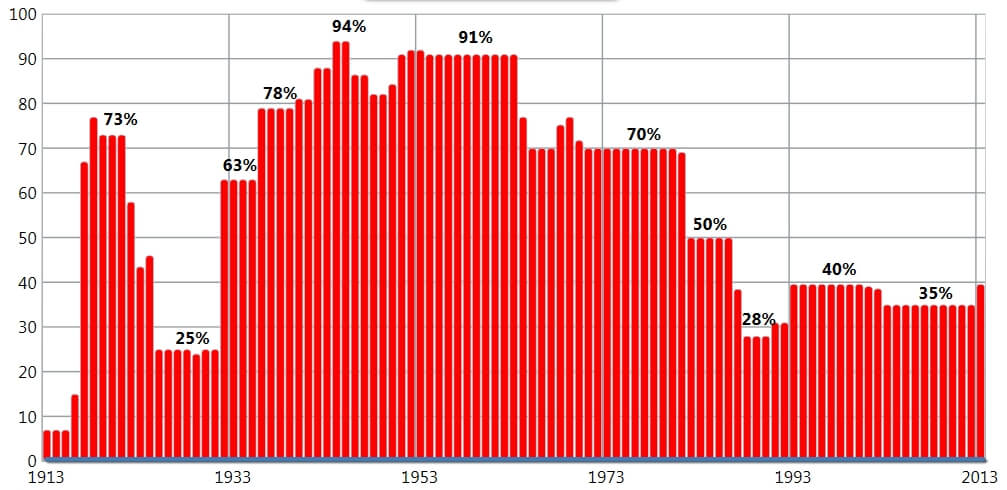
Will income TAXES increase? If you are successful, you are likely a target of the IRS. And the more you make, the more you pay. The secret is to keep more of what you earn, and to keep it in the family for generations, without triggering income taxes.
To understand the income tax, you just have to look at history. Below is a chart of the marginal tax history in the United States for the highest income earners. Most tax increases came during periods of war and new government programs.
Relatively speaking, we are actually experiencing lower tax rates today. So the question is, with all of the government spending, do you think income taxes will increase in the future?
DISCLAIMER
We do not provide tax or legal advice and accept no liability for the information we provide. You should consult your tax advisor for advice. We are not responsible for information from outside sources and the links we provide to other sources. We provide information to our clients and those who visit our website in search of education, financial information and general knowledge.